

Benjamin Lewis was one of the figures in Byron’s circle, having served as the groom to the illustrious British Romantic poet during the last two years of his life. Lewis, however, represents a unique and fascinating case of a philhellene, as he was the first African American to travel to revolutionary Greece in 1823.
Lewis was a twenty-six-year-old African American who had been born in the United States in the late 18th century. In 1822–1823, he worked in the service of Edward Trelawny, a close friend of Lord Byron. As far as we know, he was a willing attendant who knew how to care for horses and cook.

The destruction of Psara in June 1824 was one of the events of the Greek Revolution that shocked the nations of Europe and strengthened the philhellenic movement both in Europe and worldwide. The drama and self-sacrifice of the Psarians inspired numerous 19th-century artists, who, through their works, commemorated the island’s destruction by painting pictures, writing poems, or staging dance or theatrical performances.
 The Easter Resurrection Service at a Greek Orthodox church in the Troad (Source: The Illustrated London News, April 20, 1878)
The accounts of the philhellenes who traveled to revolutionary Greece and the books they published detailing their experiences are important historical sources, as they offer us insight and knowledge not only about the events of the revolution but also about the way of life, customs, and celebrations of the Greeks in the 1820s.
How was Easter celebrated during the years of the Greek War of Independence? Interesting information about Holy Saturday and the celebration of the Resurrection is provided by the British philhellene Julius Millingen, who was in Nafplio during Holy Week in 1825.
 Soldiers from Central Europe, early 19th century (Source: depositphotos.com)
During the Greek Revolution, a large number of volunteer soldiers and officers, mainly from Europe, came to revolutionary Greece to assist the Greeks in their struggle against the Ottomans. It is estimated that approximately 1.500 armed philhellenes fought during those years for the liberation of Greece.
Among the Philhellene soldiers, we find four pairs of brothers: the Bassano brothers, the Beck brothers, the Fels twins, and the Seiger brothers. We draw important information about these individuals from Errikos Fornesis’s list of Philhellenes as well as from the book “That Greece Might Still Be Free” by the distinguished Philhellene professor William St. Clair.
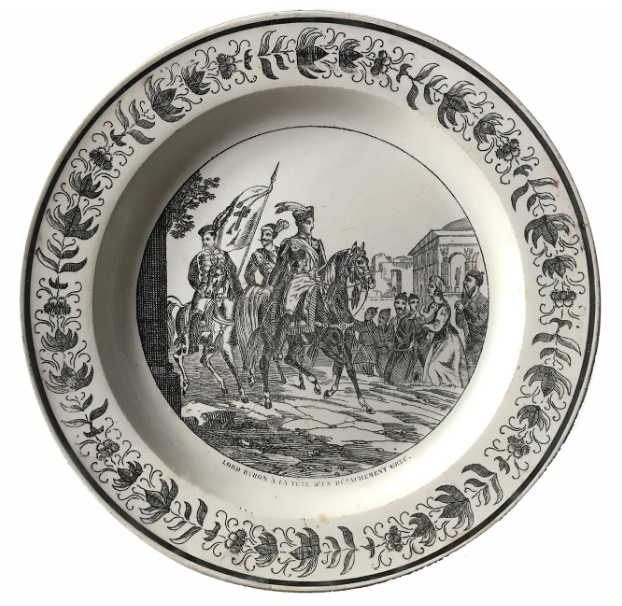
The Greek Struggle for Independence against the Ottoman occupiers triggered a massive wave of philhellenism that spread throughout Europe and even to the United States. The Greek cause was so popular that during the years of the 1821 Revolution, many decorative and utilitarian everyday objects—such as clocks, plates, and even playing cards—were produced, all inspired by the Greek Struggle.
Nowadays, we know that two decks of cards with a philhellenic theme were printed in Europe during the 1820s. One was printed in Germany in 1822, and the other in Hungary in 1829.
The German playing cards of 1822
 German playing card deck from 1822 from a private collection (Source: “Archaeology and Arts” magazine)
This deck was crafted in 1822 in Leipzig, Germany, by the German C.H. Zoelcke. It is complete and consists of 52 cards measuring 8.4 x 5.5 centimeters, which are stored in a gray box adorned with gold bands and measuring 9.3 x 6.2 x 2.9 centimeters.
 An African American soldier in the late 18th century. (Source: nps.gov.)
During the Greek Revolution, numerous philhellenic fighters from various European countries, as well as from the United States, traveled to Greece to support the Greeks’ struggle against the Ottoman occupiers. During the years of the Revolution, brave fighters such as George Jarvis and William Washington arrived from the United States and distinguished themselves on the battlefields. One of the most interesting cases of philhellenic fighters was the African American James Jacob Williams, who arrived in Greece in 1827 and died there two years later.
We have little information about his life and activities in Greece, as the available sources are limited. What we do know about Williams comes from Jonathan Peckham Miller’s book “The Condition of Greece in 1827 and 1828” (1828) and from John Lloyd Stephens’ travelogue *Incidents of Travel in Greece, Turkey, Russia, and Poland* (1838).